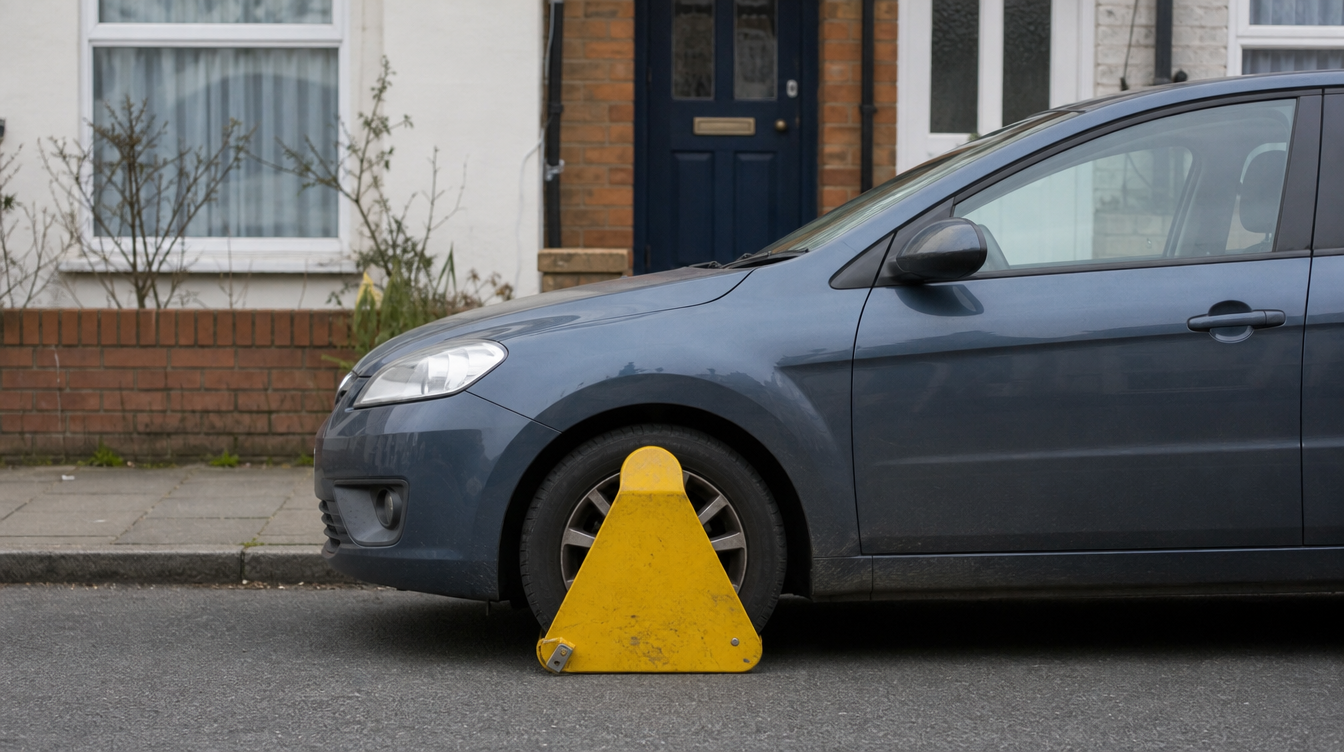
A fine is outstanding and the car refuses to start. That sounds like policy for ten years from now.
The parts are already fitted. General Motors has been able to switch off cars remotely since roughly 2009 (The Truth About Cars). The function is called Remote Ignition Block and belongs to OnStar. Tesla, Ford, Hyundai and Toyota offer comparable remote control (Newsweek). At some brands, remote immobilisation is simply part of the stolen vehicle package (The Conversation).
Who already has the button
Not the state. When financing buyers with a lower credit score, lenders and dealers routinely fit GPS-linked starter interrupt devices (Newsweek). A box like that can block the car if a payment is one day late (CBS News).
So the model is already running: an outstanding claim that stops a car from starting. That the button sits with a lender and concerns a lease instalment rather than a fine is paperwork. The technology does not know the difference.
Distance does not matter either. John Deere remotely disabled farm machinery looted in Ukraine (Swedish National China Centre). The Beach Boys sang about a father taking the T-bird away. Now a server does it, and the server is somewhere else.
From logbook to switch
The privacy conversation about the car is almost entirely about the logbook. Every kilometre is recorded, including the trip to the hotel that nobody at home needs to hear about. A log like that sits there for years, on storage whose security is opaque to the driver.
A log can be read, and that is all. The switch that can act on that log does something, and that is barely being negotiated over.
The same reasoning applies to speed. Proposals for a limiter that reads the signs along the road have been circulating for a while. A car that reads the signs and warns the driver and a car that reads the signs and ignores the accelerator differ in software. For the first variant, authorisation is arranged. For the second, it is not.
What is missing is a legal power. That is the easiest part of a car to change: nothing has to come off the production line for it.
The legal objection
The strongest counterargument is that technology is rarely the limiting factor in coercion. Law and liability are, and they are tougher than a parts list suggests. No manufacturer wants to own a car that cuts out on the motorway. The existing devices are designed around that: they prevent starting and only work with the ignition off (Vehicle HQ). Fines, moreover, have long been collected through number plate registration and bailiffs, so there is hardly any institutional hunger for a channel inside the vehicle. And the foreign bogeyman remains elusive: the Swedish National China Centre, Sweden's centre of expertise on China, states that there is no direct public evidence that the Chinese government extracts data from the connectivity modules in cars (Swedish National China Centre).
But that safety boundary is itself a design choice, laid down in the supplier's software, and software is managed remotely. For collecting fines, intervening mid-journey is unnecessary. A car that does not start is enough, and that is precisely the variant that has been sold for years as the decent one. What remains is a statutory basis and a link between two registers.
How invisible such a key can be became clear in Oslo. Ruter, the city's public transport operator, had Chinese Yutong buses examined. Technicians found undeclared, unencrypted SIM cards sending data via Romania to servers in China. Ruter called it a kill switch vulnerability, in which a foreign manufacturer or state actor could remotely deactivate an entire fleet (AEI). That took a technical audit; on the dashboard there was nothing to see.
For a private buyer, no such audit exists. Whether the vehicle has a remote block is, at best, in the small print. Who is allowed to use that power is rarely stated.
Anyone trusting the law to stop this is trusting the one component that can be changed by a simple majority. The law is not going to stop the car. It is going to give it an update.